


Drones and Drone Components: Prototypes and End-Use Products
In drone manufacturing what matters most is low weight, accurate dimensions and speed: the design is often changed after every test. 3D printing lets you produce a part in a few days, adjust the model and print again without any tooling or moulds. That is why drone developers use this technology both for prototypes and for small-batch components. You can find more about our capabilities on the 3D Printing page.
Where 3D printing is used in drones
- Prototypes and test housings. A new shape can be tried out before investing in series production.
- Components. Most often these are brackets, camera and sensor mounts, protective housings and cable guides.
- Small batches. When you need a few dozen identical parts, no mould is required. Read more in our article “Small-Batch Production Without Injection Molds: When It Pays Off”.
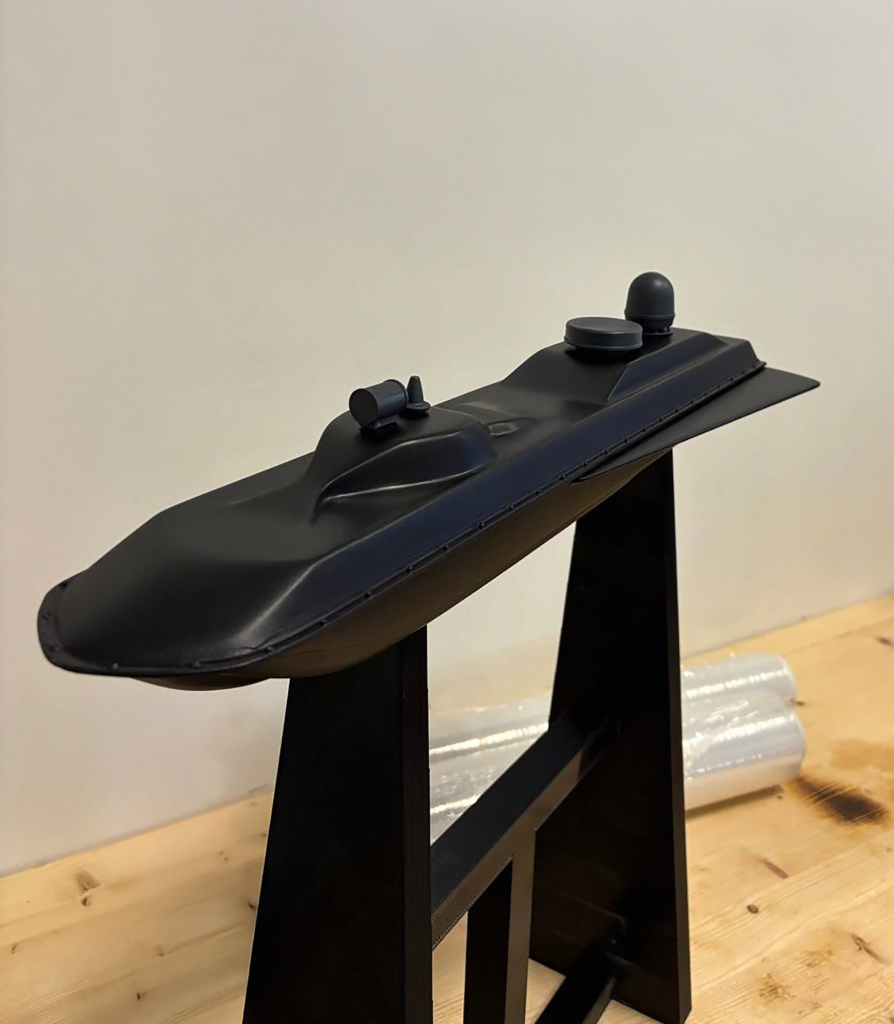
- Display copies and models. For the Latvian water drone manufacturer NEWT21 we printed scaled-down drone models for trade shows and client presentations. We used the Modix Big 60 for larger components and the Prusa MK3 for finer details, with PLA as the material.
Prototype or final part
For prototypes, FDM printing from PLA or PETG is usually enough: it is fast and inexpensive. For final, loaded parts, stronger engineering plastics are chosen, for example nylon (PA12) with SLS or MJF technologies, which can also be combined with reinforced materials. For highly loaded parts, metal printing may also be considered. We will cover the differences between technologies in separate articles.
Weight and strength
3D printing makes it possible to reduce the mass of a part: walls can be thin, and lattice or hollow structures can be formed inside, leaving material only where it is needed. Whether a part is suitable for flight is always confirmed by the manufacturer through testing, while we help choose the technology, the material and the print orientation.
Broken or discontinued parts
If you need to recreate a broken bracket or an old component that can no longer be bought, we can scan the part and build its digital model. Read more in our article “What to Do When an Industrial Part Breaks and You Can’t Buy It Anywhere” and on the 3D Scanning page.
Individual project
Every drone part is different, so we can propose the most accurate solution only when we know the operating conditions: loads, temperature, humidity and quantity. Send a 3D model, a drawing or a sample through the order form, and we will suggest the most suitable technology and material.